
On 8 September, SpaceX shares closed at $153.47, up 3.73%, taking the company’s market capitalisation back above $2 trillion. The stock had gained 7.9% over the previous five sessions.
It looked like a powerful recovery. But widen the lens and the story becomes more complicated.
SpaceX floated on Nasdaq on 12 June at $135 a share and closed its first session at $160.95. Four days later, it touched $225.64, valuing the company at roughly $2.66 trillion. The shares then collapsed to $104.83 on 3 August—a 53% fall from the peak—before rebounding 46% in just over a month.
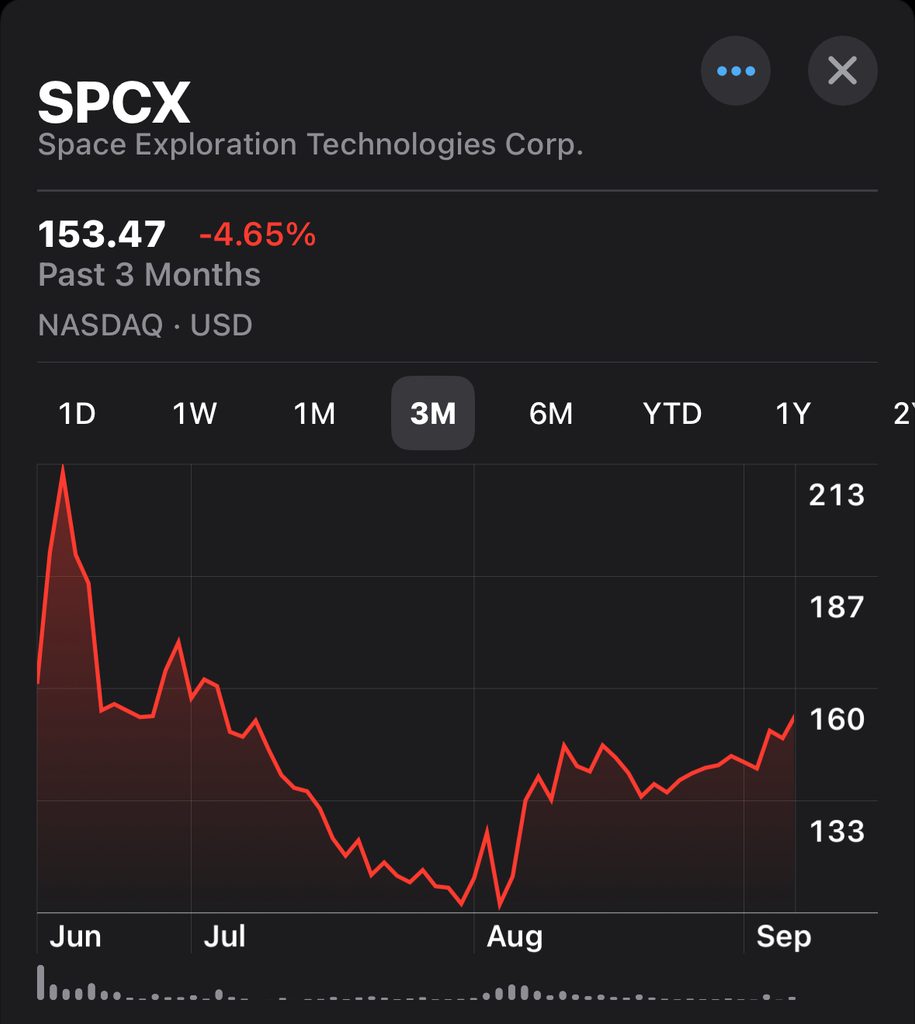
In three months, SpaceX rose 67%, fell 53% and recovered 46%. That sequence cannot be explained by improving fundamentals alone. Four forces have been interacting: the long-term promise of AI and Starship, new information from the company’s results, the extreme price sensitivity created by a tiny free float, and technical flows generated by lock-up expiries and index funds.
SpaceX’s return to $2 trillion does not necessarily mean the market has settled on a valuation. It may mean that genuine price discovery is still under way.
From day one, the share price was about more than fundamentals
SpaceX’s IPO broke records. The company sold roughly 555.6 million shares at $135 each, raising $75 billion in the largest public offering on record. The stock rose 19.2% on its first day, closing at $160.95 and taking the company’s value above $2 trillion. Four days later, it reached an intraday high of $225.64.
Demand was clearly strong, but supply was even more important. Less than 5% of SpaceX’s shares were freely tradable immediately after listing. Most of the remaining stock was still locked up. In such a thin market, even a moderate increase in demand can cause an outsized price move.
The post-IPO valuation therefore contained at least two components: investors’ long-term expectations for Starlink, Starship and AI, and a scarcity premium created by the limited float.
That is why the unlock schedule matters so much. As more shares become eligible for sale, the market must answer not only what SpaceX is worth, but whether demand can absorb the additional supply.
Why the shares fell from $225 to $105
The decline was not caused by one piece of bad news. Valuation, execution risk and market structure all came under pressure at the same time.
Nasdaq-100 inclusion was not enough
SpaceX joined the Nasdaq-100 on 7 July. About $1.7 trillion tracks the index, and JPMorgan estimated that inclusion could generate roughly $4.3 billion of passive buying.
The stock fell 6.8% that day anyway.
That does not mean the passive demand failed to arrive. It means mechanical buying was insufficient to overwhelm other selling. Short interest was already elevated, technology shares were retreating more broadly, and some investors were taking profits. Because index changes are public, traders can also position ahead of them, leaving part of the expected benefit priced in before the effective date.
It would be misleading to compare the estimated $25 billion value of outstanding short positions directly with $4.3 billion of index-related buying: the first is a stock of positions, while the second is a flow over a particular period. The more defensible conclusion is simply that bearish positioning and selling pressure were strong enough to offset the index demand.
Starship showed that the key technology was still a work in progress
On 16 July, SpaceX attempted Starship’s thirteenth flight test. Several engines failed to start, triggering an automatic abort before lift-off. The shares fell 3.1% to $131.11, below the IPO price.
The event mattered because Starship is central to SpaceX’s long-term economics. High-frequency, low-cost reusability is what could make next-generation Starlink deployments, large-scale space transport and orbital data centres economically viable.
The full timeline is important, however. SpaceX tried again on 24 July and successfully completed Flight 13, including the deployment of next-generation Starlink V3 satellites. The 16 July abort demonstrated execution risk; it was not the final outcome of the mission.
The IPO filing exposed financial fragility
SpaceX reported about $18.7 billion in revenue and a $4.94 billion net loss for 2025. In the first quarter of 2026, it generated $4.69 billion in revenue and lost $4.28 billion. Connectivity, led by Starlink, was the main source of profit, while the space and AI divisions remained lossmaking.
Starlink also showed a less flattering trend beneath its rapid subscriber growth. Monthly average revenue per user fell from $91 in 2024 to $81 in 2025 and then to $66 in the first quarter of 2026. That may be a natural consequence of expanding into lower-priced markets across Latin America, Asia and Africa, but it means future growth will depend more heavily on scale than on the value of each customer.
At a peak valuation of roughly 125 times 2025 sales, doubts about technology, profitability or future share supply were always likely to produce an exaggerated response.
Why the rebound combined real progress with technical support
SpaceX did not recover because its risks suddenly disappeared. It recovered because investors received several pieces of information that were better than feared.
Second-quarter results improved sharply, but capex remained extraordinary
On 4 August, SpaceX released its first quarterly results as a public company. Revenue reached $7.81 billion, up 92% year on year and ahead of the $6.93 billion consensus estimate. The net loss narrowed to $541 million, a substantial improvement from the $4.28 billion loss in the first quarter.
Connectivity generated $4.29 billion in revenue and $1.66 billion in operating profit. AI produced $2.56 billion in revenue but lost $1.26 billion, while the space division recorded $962 million in revenue and a $542 million operating loss. Starlink subscriptions rose to 12 million—double the previous year’s level—while ARPU remained at $66.
The uncomfortable number was spending. Capital expenditure reached $18.37 billion in the quarter, more than six times the year-earlier level and well above the $13.22 billion FactSet consensus. Of that amount, $15.83 billion went into AI.
The results therefore proved two things at once: SpaceX was commercialising its assets faster than expected, but doing so required an exceptional amount of capital.
Nvidia made the AI story more credible
The same day, SpaceX announced that it was working with Nvidia on the Starmind AI1 satellite compute payload. The first-generation system will use Nvidia’s Vera Rubin NVL72 architecture to take data-centre-class AI computing into orbit. The companies later said they were targeting initial launches in the fourth quarter of 2027 and “significant scale” in 2028.
In mid-August, Nvidia disclosed that it held about 122.8 million SpaceX shares, worth roughly $21 billion at the end of the second quarter. The stake originated in Nvidia’s earlier investment in xAI and converted into SpaceX equity after the companies combined.
This is a meaningful endorsement, but it is not proof that orbital data centres are commercially viable. Power, cooling, maintenance, latency and launch costs remain unresolved. Nvidia’s involvement raises the technical credibility of the project; it does not eliminate the economic risk.
AI contracts created revenue visibility—with important escape clauses
Anthropic agreed to pay SpaceX nearly $45 billion over three years for computing capacity, while Google and Reflection AI signed additional agreements. These contracts showed that SpaceX’s AI infrastructure could attract outside customers.
But headline contract values are not the same as guaranteed revenue. Musk said the Anthropic arrangement began as a 180-day lease, after which either side could cancel with 90 days’ notice. Reflection AI’s agreement contained a similar provision. SpaceX can reclaim capacity if its own computing needs become tight.
The deals improve near-term visibility, but they should not be treated as fully locked-in long-term cash flow.
Early unlocks were absorbed without a collapse
On 6 August, about 912 million SpaceX shares became eligible for sale. A further tranche of roughly 319 million shares followed on 20 August under the prospectus’s staggered schedule. Investors had feared that the additional supply would overwhelm the market, but actual selling was less severe than the most bearish forecasts.
Eligibility is not the same as a sale. An unlock expands potential supply; its effect depends on whether shareholders choose to sell and whether buyers are willing to absorb the stock.
The orderly response to the first two unlocks encouraged investors to reduce their estimates of near-term selling pressure.
Wall Street optimism and index front-running amplified the move
After the underwriters’ quiet period ended, several banks initiated positive coverage. Morgan Stanley set a $300 target and Goldman Sachs $205. Pivotal Research began coverage on 8 September with a Buy rating and a $220 target.
The wide valuation range is itself revealing. Morgan Stanley’s bull case was $600, while its bear case was $75. Pivotal’s thesis assumes that each Starship can eventually fly 20 to 50 times with rapid, relatively inexpensive refurbishment. If that assumption fails, the valuation changes dramatically.
Meanwhile, the Nasdaq-100 is due to complete its quarterly rebalance on 21 September. As SpaceX’s free float rises, JPMorgan estimates that its index weight could increase from 1.25% to 2.25%, generating about $15.5 billion of net passive buying.
Because the rules and timetable are public, active traders can buy in advance and sell into index-fund demand on the effective date. This front-running can lift a stock in the short term, but it is not evidence that intrinsic value has risen by the same amount.
The real test comes after $2 trillion
On 9 September, another 319 million SpaceX shares became eligible for sale. More than one billion additional shares are expected to unlock by the end of October, followed by roughly 1.3 billion after the company reports third-quarter results in mid-November.
At the same time, the 21 September index rebalance could create an estimated $15.5 billion of passive demand. New supply and mechanical buying will arrive together. The direction of the share price cannot be inferred from either number in isolation.
SpaceX is also unlikely to receive another immediate boost from the S&P 500. The index requires at least 12 months of trading history, so the company will not meet that threshold until mid-2027 at the earliest; profitability requirements would still have to be satisfied separately.
More important than either unlocks or index flows are two long-term questions.
First, can Starship achieve rapid, low-cost reusability? Pivotal’s $220 target depends heavily on a future in which each vehicle can fly 20 to 50 times. SpaceX has demonstrated that Starship can fly and completed Flight 13 on 24 July, but dependable, fast-turnaround commercial reuse remains a distant engineering goal.
Second, can the AI division generate sustainable returns on extraordinary capital spending? The unit’s revenue is growing quickly, but it still lost $1.26 billion in the second quarter and accounted for $15.83 billion of capex. Nvidia’s participation and external compute contracts improve the odds of success without removing the financing risk.
Ed O’Gorman, chief executive of River Wealth Advisors, captured the price-discovery problem neatly:
“The market price is going to get shoved around here by, to some degree, forced buying. It is going be some time until I think you really get a good read on what the market truly thinks about the stock.”
SpaceX is back at $2 trillion. That does not mean the answer has arrived.
It means the debate is entering its next phase: is SpaceX a future infrastructure company worth $2 trillion, or a high-risk asset whose price has been magnified by a scarce float, the AI narrative and compulsory index buying?
Sources and notes
Data note: Unless otherwise stated, all market and share-price data are as of the close on 8 September 2026.