Why Entrepreneurship Is the Only Real Path to Financial Freedom?

Many people get used to the comfort of a stable yet modest income. While this may seem safe, it can be quite dangerous in the long run. Remaining in the comfort zone for too long often leads to a loss of ambition and a reluctance to take risks. If you are always hesitant to try new things or take calculated risks, you may find yourself trapped in mediocrity, unable to achieve genuine freedom.

Image generated by AI.

Is Entrepreneurship the Only Way?

It is not necessary for everyone to start a business right away. However, if financial freedom is your goal, entrepreneurship is arguably the most effective route. The first step is to plant the seed of entrepreneurship in your mind and start accumulating the skills and resources you will need in the future.

The True Nature of Entrepreneurship

Starting a business is often misunderstood as something lofty or out of reach. In reality, it comes down to two fundamental questions:

  1. What can you sell? In other words, what is your unique product or service?
  2. Who will you sell it to? Who are your target customers, and how will you reach them?

If you focus on developing a good product and finding a reliable way to attract customers, your entrepreneurial journey becomes much clearer and more practical.

The Case for Low-Cost Start-Ups

For most people, especially those just starting out, investing a large amount of money into a business is unwise. Low-cost or “light asset” entrepreneurship, such as online businesses or knowledge-based services, comes with lower risks and allows for faster learning and adaptation. In my own experience, providing knowledge-based services has allowed me to help others while generating income, all with minimal upfront investment.

Where Are the Opportunities for Young People?

Young entrepreneurs should consider the following approach:

  • Utilise internet platforms
  • Focus on low-cost business models
  • Target specific and high-demand markets
  • Offer essential, in-demand products or services

Avoid heavy investments in traditional businesses. Otherwise, you may end up following the same path as previous generations: years of schooling, decades of paying off a mortgage, and ultimately, a life of missed opportunities.

The Three Core Questions of Entrepreneurship

Whether you are starting alone or building a team, these are the three critical questions you must answer:

  1. What is unique about your product or service?
  2. How many customers are willing to pay for it?
  3. Can you set a price that allows your business to be sustainable in the long term?

Most new entrepreneurs struggle with at least one of these questions, particularly when it comes to attracting clients and setting the right price.

Entrepreneurship Is Not an Escape

It is important to remember that entrepreneurship is not an easy way out of workplace stress or dissatisfaction. Starting a business comes with its own set of challenges. Rather than using entrepreneurship as a form of escapism, adopt a mindset of facing problems head-on and being prepared to learn continuously.

How Should You Begin?

The best strategy for most people is to start with a side venture. By experimenting with a small-scale, low-risk project, you can test your ideas and build confidence. If your side project starts to generate meaningful income and shows signs of growth, then you can consider transitioning into full-time entrepreneurship. This approach helps you gain valuable experience while minimising the risks associated with failure.

In summary

Financial freedom cannot be achieved by settling for a stable but low income. Entrepreneurship remains the most practical path to upward mobility. The key is to be willing to try, to keep learning, and to start small. With persistence and the right strategy, true freedom is within reach.

Medium vs Substack: Which Platform Is Right for You?

If you’re a writer looking to share your ideas online, you’ve probably come across Medium and Substack. Both platforms are popular choices for creators, but they serve different needs and audiences. So how do you decide which one is best for you?

In this article, I’ll break down the key differences between Medium and Substack, including their global popularity, how they help you build an audience, their monetization models, and what each means for your growth as a writer.

What Are Medium and Substack?

Medium is an online publishing platform where anyone can write articles and share stories with a built-in audience of millions of readers. Topics range from technology and culture to personal development and beyond. Think of Medium as a giant online magazine fuelled by both independent voices and established publications.

Substack is designed for newsletters. It lets you send your writing directly to your subscribers’ inboxes, and it’s become a go-to for writers who want to build a direct relationship with their readers. You can decide whether each post is free or paid, making it a great option for those interested in developing a dedicated community around their work.

Popularity: App Store Rankings

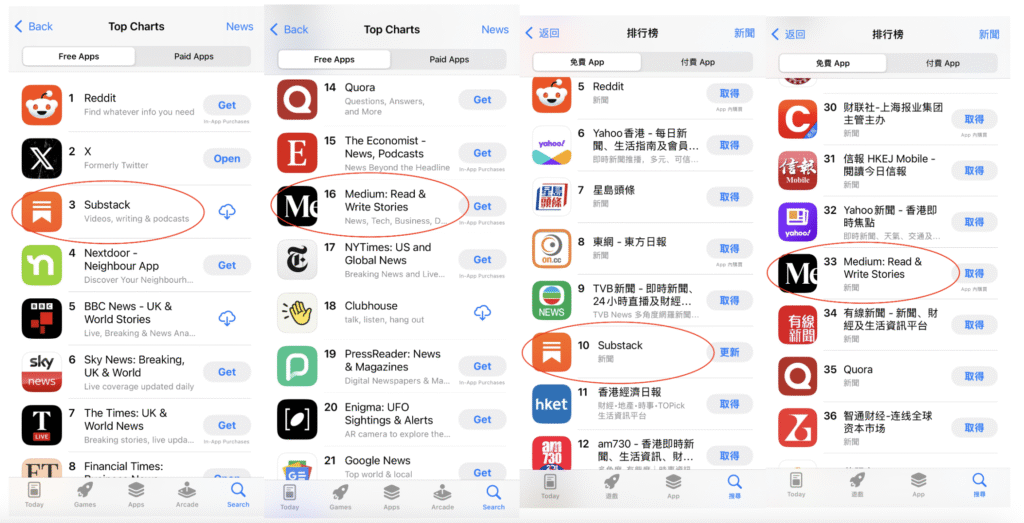
Substack’s influence is clearly growing worldwide. Just look at the latest App Store rankings in the News category:

  • In the UK App Store, Substack is ranked #3, while Medium sits at #16.
  • In the Hong Kong App Store, Substack is #10 and Medium is #33.

These numbers show that Substack is quickly gaining traction, especially among readers who value independent content and direct communication.

Audience Building, Discovery, and Interaction

Substack uses a subscriber model: people sign up to receive your content directly in their inboxes. This setup is perfect for writers who want to cultivate a direct relationship with their audience or foster a sense of community. If you already have readers who appreciate your work, Substack makes it easy to keep them engaged and updated.

Medium, by contrast, is all about algorithmic discovery. Readers pay $5 per month to access all content on the platform, but what they actually see is driven by Medium’s recommendation algorithms. As a writer, this means you can focus on producing great articles—if the quality is high, your work may be pushed to more readers, even if you’re new and don’t have a large following. However, your follower count on Medium doesn’t guarantee more views for your future posts. Each article is judged on its own merit, much like how TikTok’s content system works.

Monetization

Both platforms offer ways to earn money, but the approaches are different:

  • Medium: Once you join the Partner Program, you get paid based on the amount of time paying members spend reading your stories. The platform manages all payments, and your earnings depend on your reach and engagement.
  • Substack: You control your own pricing and decide which content is free or paid. Subscribers can pay monthly or annually, and most of the revenue goes directly to you, minus a small platform and processing fee.

Which Platform Should You Choose?

So, which platform is best for you?

  • If you’re just starting out and don’t have an established audience, Medium is a strong choice. Thanks to its algorithm, even new writers can gain exposure if their content stands out.
  • If you already have a group of readers, or you want to build a more direct relationship and community, Substack is ideal. It’s especially powerful for writers who want to control their own mailing list and nurture a loyal readership.

Many creators actually use both: Medium for wider reach, and Substack for deeper engagement with their most dedicated subscribers.

Final Thoughts

Choosing between Medium and Substack depends on your goals as a writer. If you want to tap into a massive built-in audience and let the platform’s algorithm do some of the work, Medium is a great place to start. If your focus is on building a personal newsletter, fostering deeper connections, and owning your audience, Substack is hard to beat.

Why University Won’t Teach You How to Make Money?

University doesn’t teach you how to make money. It teaches you how to become a useful tool for others to make money.

You are trained to be useful labor, ready to fit into someone else’s system.

But how to actually make money? That is never taught.

Some people say, “If I study hard and get a good job after graduation, I can make money.” But that’s just earning money, not making money.

What’s the difference?

Earning money means trading your time and labor for money. Once you stop working, the money stops too.

Making money means using leverage—such as labor, capital, media, or code (as Naval Ravikant talks about). None of this is taught in university.

Most graduates only pick up some skills for earning money, not for making money. In the era of artificial intelligence, even the skills for earning money can be easily replaced by AI.

So how do you actually make money?

It is about mastering assets. For example, owning shares of great technology companies means your money works for you, not the other way around. It is about building things that generate income on their own, without you having to constantly trade your time and labor.

This could be creating a product—something digital, like an app or an online course, or content like a YouTube channel. Once you have built these, you can sell them again and again. Even while you are sleeping, they can still bring in money.

When you start using these kinds of leverage, you can reach more people and create more value, far beyond what you could do with your own labor alone.

Making money means letting assets and leverage work for you, instead of always working for money. This is the real path to financial freedom, but none of this is taught in university.

If you want to break free from the cycle of earning money with your labor, start learning how to build assets and use leverage. That is how you make money work for you—and that is where real financial independence begins.

How Entrepreneurs Can Master Knowledge Management

As an entrepreneur, you probably have a habit of taking notes. But have you ever experienced this: you write something down, only to forget about it later? Or perhaps you record your thoughts, but when you need them, you can’t figure out how to use them effectively.

Regularly organising your notes seems like a good idea, but often it doesn’t help much. The process itself is time-consuming and mentally draining. Even after you’ve sorted through everything, it’s easy to forget what you’ve organised.

So, is there a better way? Here’s a method I’d like to share: Start by recording questions instead of just notes. Then, look for which of your notes can help answer those questions.


What Kind of Questions Should You Record?

Here are three types of questions that work especially well:

  1. Decision-making
    For example: Should I pursue this project? What are the criteria for making this decision?
  2. Confusion or Uncertainty
    For example: Why are the costs for this project so high? What are the underlying reasons? (Think of Elon Musk’s “first principles” approach.)
  3. Curiosity
    For example: How did someone achieve this? What can I learn from their process?

You can even go back and transform your previous notes into a series of questions and answers.


Why This Works

A good question is the key to capturing and focusing your attention—whether it’s your own attention, or someone else’s. Real thinking doesn’t come from endlessly organising notes, but from exploring with questions in mind. Often, it’s not that we don’t have enough notes, but rather that we don’t have enough good questions.

The value of note-taking isn’t in the act of recording, but in whether your brain can recall the right information at the right time to help solve a problem.

Remember: Your brain is a CPU, not a hard drive. Stop trying to store everything. Instead, learn how to call up knowledge intelligently, just when you need it.


Final Thoughts

Turn your notes into a toolkit of questions and answers. Let questions guide your exploration and learning. With this approach, you’ll find that knowledge management becomes less about storage and more about smart, active retrieval—and that’s what truly empowers entrepreneurs to solve problems and grow.