
Investors cheered a weak jobs report. For a Fed that had just raised rates, the revisions are harder to shrug off.
On Friday, Wall Street got the jobs report it had been hoping for: a bad one.
The US economy added just 29,000 jobs in September, according to the Bureau of Labor Statistics, well short of the 84,000 to 90,000 that economists had forecast. The previous two months were revised down by a combined 60,000, pushing July into negative territory, and the unemployment rate edged up from 4.1% to 4.2%. Investors were delighted, and the Nasdaq Composite briefly hit a record high.
For the Federal Reserve, the timing could hardly have been more awkward. Little more than two weeks earlier, it had raised interest rates for the first time since 2023, partly on the strength of a labour market that appeared to be holding up well. Friday’s figures raise two uncomfortable questions. Did the Fed tighten policy on the basis of information that has since proved wrong? And, more broadly, how far can anyone trust the numbers that are supposed to tell us how the economy is doing?
Why Bad News Was Good News
The market’s logic is easy enough to follow. A cooler labour market means less pressure on wages. Slower wage growth makes it less likely that inflation becomes entrenched. And the smaller the inflation risk, the less reason the Fed has to keep raising rates.
On that score, the report delivered. Average hourly earnings rose just 0.1% in September, against expectations of 0.3%, and annual wage growth slowed to 3.0%, the weakest since May 2021. At the start of the week, according to Citi, markets had been pricing in a better-than-even chance of another rate rise at the Fed’s October meeting. Those odds had already slipped on Wednesday, when the Fed’s preferred inflation gauge, the personal consumption expenditures price index, came in cooler than expected. After the jobs report, CME’s FedWatch tool put them at just 17%. Traders still expect a rise by December, but October now looks all but off the table.
Oil helped too. Brent crude briefly dipped below $100 a barrel after G7 countries agreed to release 100m barrels of crude and diesel over four months, easing fears that energy costs would keep feeding inflation. By the close, the Nasdaq was up 1.19%, the S&P 500 0.73% and the Dow Jones Industrial Average 0.49%. Nvidia led the way, jumping more than 3% to an all-time high and lifting its market value to about $5.7tn.
The Numbers Moved After the Fed Did
The Fed’s decision on 16 September was unanimous: a quarter-point rise that took the federal funds rate to a range of 3.75% to 4%. Its statement said that economic activity was “expanding at a solid pace”, that “domestic spending has been resilient” and that “job gains have kept pace with the workforce, and the unemployment rate has changed little”. Inflation, by contrast, “remains elevated”. Core consumer prices had risen 0.3% in August, ahead of the 0.2% economists had expected, and energy prices were up 16.3% on a year earlier.
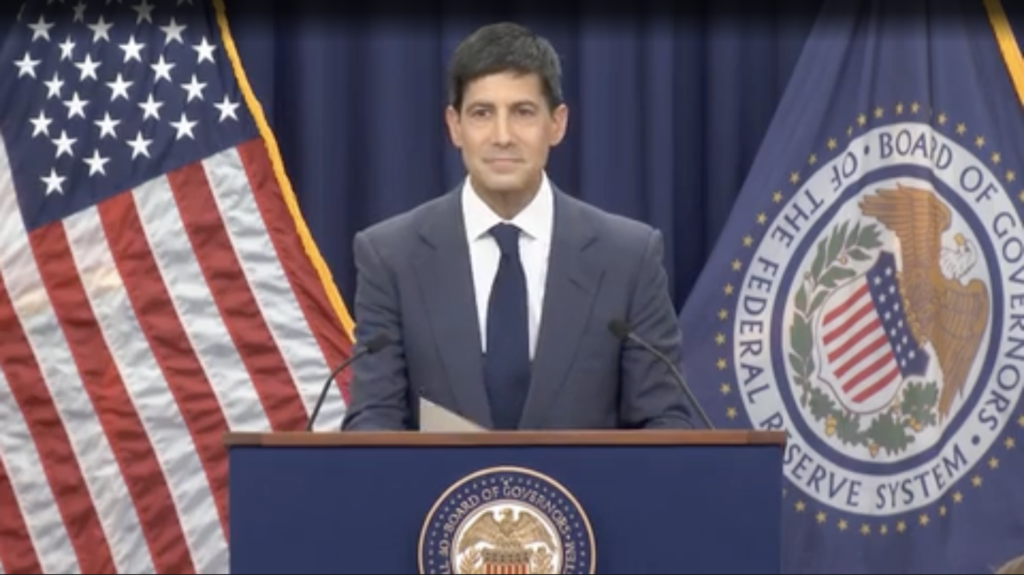
Kevin Warsh, the Fed chair, had set out his priorities at Jackson Hole in late August. “Inflation is running above our 2 percent target,” he said. “So the Fed’s predominant focus right now should be on prices.” At his press conference after the September meeting, he added that “the labor side of the Fed’s congressional remit is in good shape”.
The hike, in other words, was mainly about inflation, but it rested on the assumption that the labour market could take it. That assumption now looks shakier. Since the meeting, August’s payrolls gain has been cut from 162,000 to 133,000, and July, which showed a small gain when the Fed met, now shows a loss.
Here is the irony. In the same Jackson Hole speech, Warsh warned that the Fed “must interrogate reality to make sure we are not setting forward-looking policy based on stale or inaccurate data”. Within weeks of his first rate rise, some of the data behind it had turned out to be just that.
So did the Fed get it wrong? There is no simple yes or no. Warsh himself has argued that policy should not hinge on any single release. “Trends matter. Data points are noisy,” he told reporters in September. “Data point dependence is a dangerous preoccupation.”
Opinion is divided. Nick Timiraos, the Wall Street Journal’s chief economics correspondent, wrote that the “ho-hum labor market report doesn’t really change the story for the Fed”, noting that senior officials had already signalled that an October rise was probably not their base case. He added: “The biggest development was what it didn’t show: few signs from wages or the unemployment rate that the labor market is tightening in ways that would add meaningfully to price pressures.”
The hawks are less relaxed. Beth Hammack, president of the Cleveland Fed, dissented in July in favour of a rate rise, warning that “inflation has remained stubbornly above 2 percent for more than five years, and I am not confident it will return to our objective on its own”. In August, she argued that the longer the Fed waited, the longer it would miss its 2% target, and the harder inflation would be to bring down.
Others see less need for aggressive action. Liu Gang, chief overseas strategist at CICC, argues that unless oil prices spiral, there is no basis for a series of large rate rises. Citi’s Andrew Hollenhorst, writing before the report, played down the jobs data altogether: “The Fed’s reaction function has become more sensitive to spot inflation data and energy prices.” In his view, it is September’s core inflation figure, due on 14 October, that will settle the matter.
There is no consensus. And behind the disagreement lies a more basic problem: the numbers themselves keep moving.
Why the First Estimate Is So Often Wrong
None of this means the figures are being manipulated. The explanation is more mundane—and in some ways more worrying.
The headline payrolls number comes from the Current Employment Statistics survey, which samples about 119,000 businesses and government agencies covering roughly 622,000 worksites. The unemployment rate comes from a separate survey of about 60,000 households. Because the payroll survey counts jobs rather than people, someone with two jobs is counted twice.
Crucially, the first estimate is published before all the responses are in. According to the Congressional Research Service, the collection rate for the first preliminary estimate averaged just 60.4% in 2024, and it has been on a downward trend since 2015. The Richmond Fed notes that response rates among private businesses have fallen by about 20 percentage points since the early 2010s. As late responses arrive, the numbers change.
Then there is the “birth-death” model. A survey of existing businesses struggles to capture firms that have just opened or just closed, so the BLS assumes that employment at closed firms follows the same trend as at those still reporting, and uses a statistical model based on the past five years to fill the remaining gap. When the economy is turning, a model anchored in the past is liable to lag behind. Goldman Sachs economists concluded that the adjustment had probably been too generous in the second half of 2024.
The revisions can be startling. In August 2024, the BLS’s preliminary annual benchmark revision cut 818,000 jobs from the 12 months to March 2024—the largest since 2009—lowering average monthly job growth over that period from 242,000 to about 174,000. A year later came an even bigger cut: 911,000 jobs, reducing average monthly growth from 147,000 to about 71,000. It was the largest preliminary revision in records going back to 2000.
Monthly revisions can be just as jarring. In the summer of 2025, May’s payrolls figure was cut from 144,000 to 19,000 and June’s from 147,000 to 14,000—a combined reduction of 258,000 and, according to the Richmond Fed, the largest two-month revision since at least 1978, excluding the pandemic. On the day those revisions were published, President Donald Trump fired the BLS commissioner, Erika McEntarfer.
This year has brought more of the same. July was first reported as a loss of 23,000 jobs, then revised to a gain of 21,000, and now stands at a loss of 10,000. One month, three estimates, and the sign has flipped twice.
Even Jerome Powell, Warsh’s predecessor, acknowledged the problem. “There’s been something of a systematic overcount,” he said in December last year, estimating that payroll growth was being overstated by about 60,000 a month. Yet the Fed has had little choice but to keep relying on these statistics.
The causes are largely technical. But the conclusion is hard to dispute: initial estimates are unreliable, and the revisions are too large to dismiss as noise. That leaves an uncomfortable question hanging over the decisions built on them—including the Fed’s.
The One Story Markets Still Trust
Markets, though, do not dwell on such questions for long. When the economic picture is murky, money tends to flow to wherever certainty seems greatest. Right now, that means artificial intelligence.
Nvidia’s record on Friday was the clearest expression of that. Growth stocks are particularly sensitive to expectations about interest rates, and a lower chance of another Fed hike made their valuations easier to justify. But Nvidia also has a story of its own. In August, it issued its first-ever forecast for the year ahead, projecting revenue growth of 70% in its next fiscal year. Jensen Huang, its chief executive, made clear that the limit was supply rather than appetite, telling analysts that “our demand is much greater than 70%”.
Is that confidence justified? Judging by the share price, the market’s answer is yes. At a time when even the most basic economic statistics keep shifting, AI looks like the most certain story in town, and investors are voting with their money.
That may be the real lesson of Friday’s report. Markets can always find a story to believe in; policymakers and the public have a harder problem. If even the data behind the Fed’s decisions keeps being rewritten, how many of the economic numbers we see every day can we actually believe?
Selected Sources
- US Bureau of Labor Statistics, “The Employment Situation: September 2026”, 2 October 2026.
- US Bureau of Labor Statistics, “Employment Situation Technical Note”, 2 October 2026.
- US Bureau of Labor Statistics, “CES Net Birth-Death Model”.
- US Bureau of Labor Statistics, “Consumer Price Index: August 2026”, September 2026.
- Federal Reserve, “FOMC Statement”, 16 September 2026.
- Federal Reserve, “Transcript of Chair Warsh’s Press Conference”, 16 September 2026.
- Kevin Warsh, Federal Reserve, “Speech at Jackson Hole”, 28 August 2026.
- Federal Reserve, “Transcript of Chair Powell’s Press Conference”, 10 December 2025.
- Reuters, “US job growth undershoots expectations in September”, 2 October 2026.
- Reuters, “US suffers unexpected job losses in July”, 7 August 2026.
- CNBC, “Jobs report September 2026”, 2 October 2026.
- CNBC, “Traders now see little chance of a Fed rate hike in October”, 2 October 2026.
- CNBC, “Nvidia leads Nasdaq to intraday record”, 2 October 2026.
- AFP, “Oil prices drop on G7 fuel release”, 2 October 2026.
- Nick Timiraos, “Post on X”, 2 October 2026.
- Reuters via Kitco, “Fed’s Hammack says tighter monetary policy needed to cool inflation”, 31 July 2026.
- Jennifer Schonberger, Yahoo Finance, “Hammack: it will take more than one rate hike to bring down inflation”, 10 August 2026.
- Investing.com via Yahoo Finance, “October Fed meeting hinges on this key economic data, Citi says”, 28 September 2026.
- CICC Research via Wallstreetcn, “中金:美联储加息一次够么?” (in Chinese), September 2026.
- Congressional Research Service, “Current Employment Survey Monthly Revisions”, 14 August 2025.
- John O’Trakoun, Federal Reserve Bank of Richmond, “Answers Don’t Come Easy”, 26 August 2025.
- Brandon Kochkodin, Forbes, “Big Jobs Revision Shows Birth-Death Model Needs a Fix”, 10 September 2025.
- Bloomberg via Los Angeles Times, “Revised figures show much lower annual US job growth”, 21 August 2024.
- NPR, “BLS revision shows hiring was overstated by 911,000 jobs”, 9 September 2025.
- Reuters, “US payrolls benchmark revision suggests labor market weaker than thought”, 9 September 2025.
- CNBC, “Trump fires commissioner of labor statistics”, 1 August 2025.
- Kif Leswing, CNBC, “Nvidia’s 70% growth forecast puts it on track to become tech’s No. 2 company by revenue”, 26 August 2026.